
Missed Connections: The weddings I designed, fell for, and never got to build.
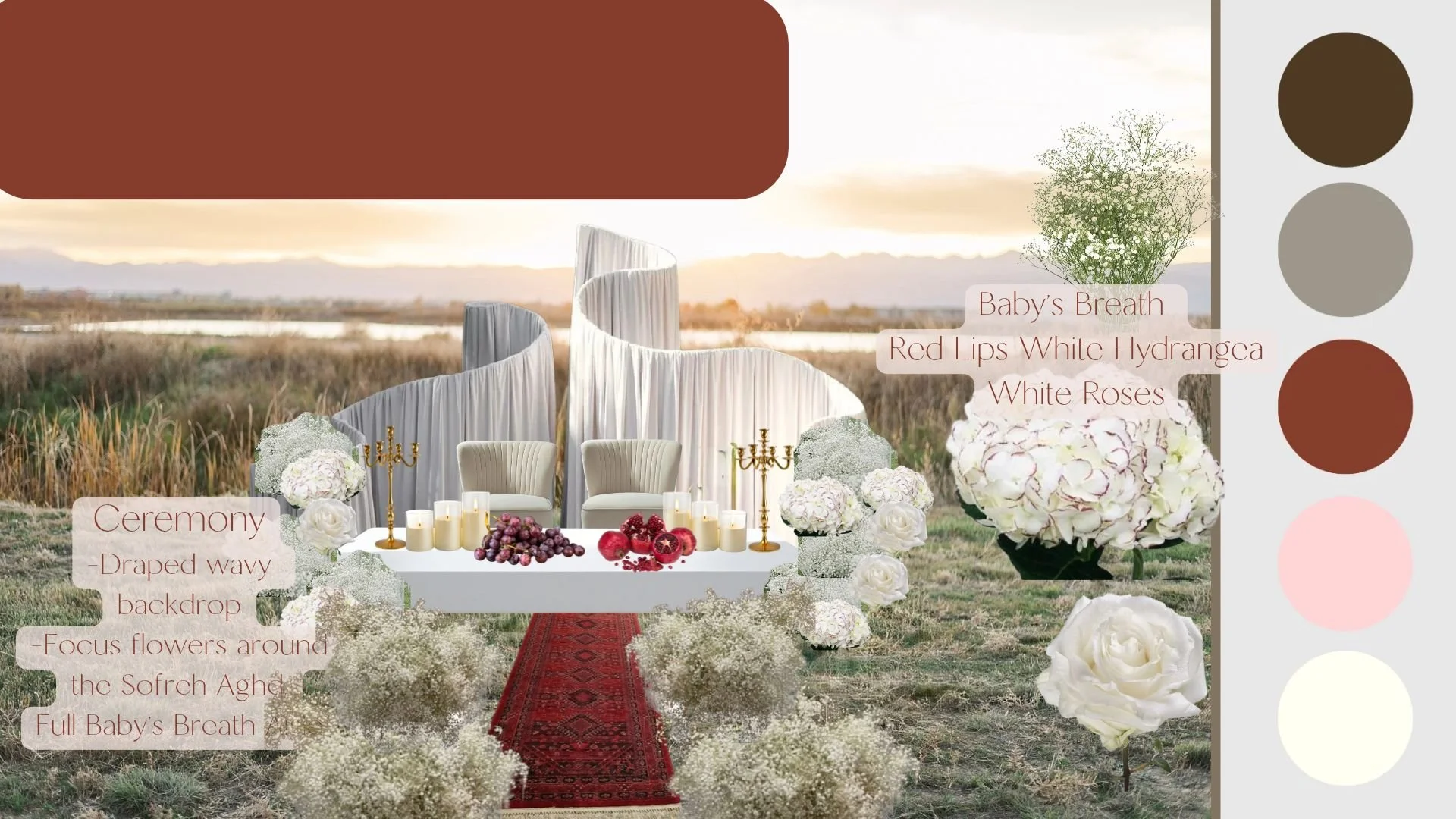
On paper, it was a white wedding. It had other plans.
The brief came through a planner: a Persian bride, an Indian groom, and a celebration at Cherry Valley Venue in Franktown, Colorado, that needed to hold both families. The palette was mostly white and cream, with chocolate, taupe, and blush underneath and a few moments of deep red.
That's a lot more restraint than I'd naturally reach for with an Indian wedding. But the palette wasn't mine to change. My job was to make it interesting.
What I cared about most was honoring both cultures without turning either one into decoration.
Starting at the sofreh
The ceremony was built around the sofreh aghd, the traditional Persian ceremony spread. I read up on what each piece of it means before I designed a single thing around it.
Then I gave it the room. A draped, wavy backdrop behind it. A full baby's breath aisle leading up to it, with a red Persian rug running down the middle. Most of the ceremony flowers gathered right around the sofreh, so everything pointed at it.
Making the fruit mean something
The couple wanted fruit on the tables. I wanted it to mean something.
By that point, the Persian side of the design had a lot to say, and the groom's side felt quieter. So I went looking for fruit with real significance at Indian weddings, and that's how I landed on the pomegranate. It matters in Persian tradition too, which made it the rare detail that belonged to both families at once.
Pomegranates became bud vases for cocktail hour, set alongside little table lamps on the cocktail tables. They ran with grapes down the head table and showed up again on the sofreh.
The rest of the personal details carried both histories. Instead of boutonnieres, the groom and his groomsmen would wear vintage Persian brooches I'd hunted down on Etsy and eBay. The bridesmaids would carry callas and nothing else, with jewelry wrapped at the stems to echo the brooches. Vintage brass Indian vessels held more of the flowers.
None of it was a checklist of cultural references. Not every guest would know why the pomegranates were there, and they didn't need to. The details meant something either way.
Then I found the hydrangeas
The plan was mostly white flowers with a few dramatic hits of red.
Then I found white hydrangeas edged in red, and the whole thing tipped.
Red didn't have to be a separate idea anymore. It could bleed in. So it did. Red-lipped orchids went into the bridal bouquet with white roses and callas. The bar became a statement piece of its own, with hydrangeas, orchids, anthurium, red callas, fruit, and grass, pulling in more color than anywhere else in the room.
Nothing did just one job
A lot of this design moved. The baby's breath lining the aisle would become clouds hanging over the round tables and sit at the front of the long ones. The ceremony flowers would go to the base of Cherry Valley's staircase and around the fireplace, so the reception would open with pieces guests had already seen once, in a new spot.
Quiet tables, one loud one
The guest tables stayed restrained: single reflexed white roses down the center, glass hurricanes, and vintage brass candlesticks in ribbed sleeves.
The head table did not. Single red callas, the grape and pomegranate runner, and a cascade of red callas and hydrangeas spilling down the front.
The palette was restrained. The design absolutely was not.
What it would have cost
The original proposal came in around $14,000, and that already included a few candles I'd added at no charge. I pared it back to a version around $10,000. Only after that did I learn the bride wanted to spend under $7,000.
You can design a beautiful wedding for under $7,000. You can't design this one. It worked because of everything stacked together, and cutting it that far would have made it a different wedding.
So we went our separate ways.
Which is the real lesson here, and it isn't about the money. It's about when I knew it.
When I know your range from the start, it shapes the design from the very first idea. It decides where the big moments go, which flowers earn their place, and what gets left alone. By the time I learned the number here, I'd already designed this wedding twice. All that was left was subtraction, and subtracting from something built to work as a whole rarely makes it better.
So tell your florist the number. Not so the design gets smaller, but so it gets built for you from the beginning.
I'm sharing all of this because almost nobody does. Wedding inspiration rarely comes with a price tag, and the gap between a pretty mood board and something that can actually be built is real. You deserve to know what's on the other side of it.
The missed connection
They had a beautiful wedding. I've seen the photos, and I'm genuinely happy they got a day they loved.
I'm also completely convinced this design would have been extraordinary.
Both things are true.
I still love the red head table, the pomegranate vases, the brooches, the baby's breath clouds, and those ridiculous hydrangeas. I wouldn't change a thing.
It just wasn't the right investment for them. The design is still here, though, and still looking for its people. Maybe another Persian-Indian wedding. Maybe a couple who wants their culture in the flowers without it reading like a theme. Or maybe someone who just thinks a white wedding could use a little more trouble.
I'd love to have that conversation.
Planning a wedding at Cherry Valley Venue, or anywhere in Colorado? Tell me about it →